TREATMENT OUTCOME IN HIV+ PATIENTS
RECEIVING 3- OR 4-DRUG REGIMENS DURING PHI
\
GM Bottani
1
, ML Oreni
1
, G Orofino
2
, P Tau
1
, S Di Nardo Stuppino
1
, E Colella
1
, S Carosella
2
, M Guastavigna
2
, V Ghisetti
3
,
V Micheli
4
, M Galli
1
, S Rusconi
1
[1]
University of Milan, DIBIC Luigi Sacco, Infectious Diseases Unit, Via G.B. Grassi 74 , Italy;
[2] Amedeo di Savoia Hospital, Infectious Diseases Unit A, Turin, Italy;
[3] Amedeo di
Savoia Hospital, Microbiology and Virology Laboratory, Turin, Italy; [4] University of Milan, DIBIC Luigi Sacco, Clinical Microbiology, Virology and Bioemergency, Italy
Background
The current international guidelines recommend antiretroviral therapy (ART) to be offered to all persons with early HIV infection, although definitive data are lacking as to whether this
approach will result in long-term virologic, immunologic, or clinical benefits
1
. Moreover, the optimal timing and modality of therapeutic intervention during early phases of HIV infection
is still debated, in particular the advantage to administer treatment within Fiebig stages I-IV (when Western Blot is still indeterminate, lacking concomitant positivity for two of the bands
among p24, gp41, gp120/160)
2
.
In our prospective observational study we evaluated immunological and virological outcome in HIV+ patients (pts) treated during acute or recent HIV infection.
Materials and Methods
A total of 25 naïve pts with acute (detectable HIV-RNA, Fiebig stages I-IV) or recent (documented infection within 6 months) HIV infection were recruited at the Infectious Diseases Units
of the University of Milan and Turin from 2009 to 2014. Pts received treatment according to individual characteristics and needs with 2 NRTIs + 1 NNRTI/bPI, with or without an
induction phase with an additional 4th drug (raltegravir in 12 pts or maraviroc in 3 pts) until HIV-RNA undetectability maintained for 6 months. Blood samples for HIV-RNA, lymphocyte
subsets and tropism assessment were obtained at the beginning of treatment (BL). Afterwards, pts underwent subsequent 6-monthly follow up for clinical outcome, CD4 cell count and
HIV-RNA up to 18 months.
Results
We first considered differences between the two distinct groups of acute (n=18) and recent (n=7) infection.
In our sample we noted the presence of two patients harboring the X4 strain, one in each phase of disease. The CD8 T cell count at baseline was higher in the first group [1625/µL, IQR
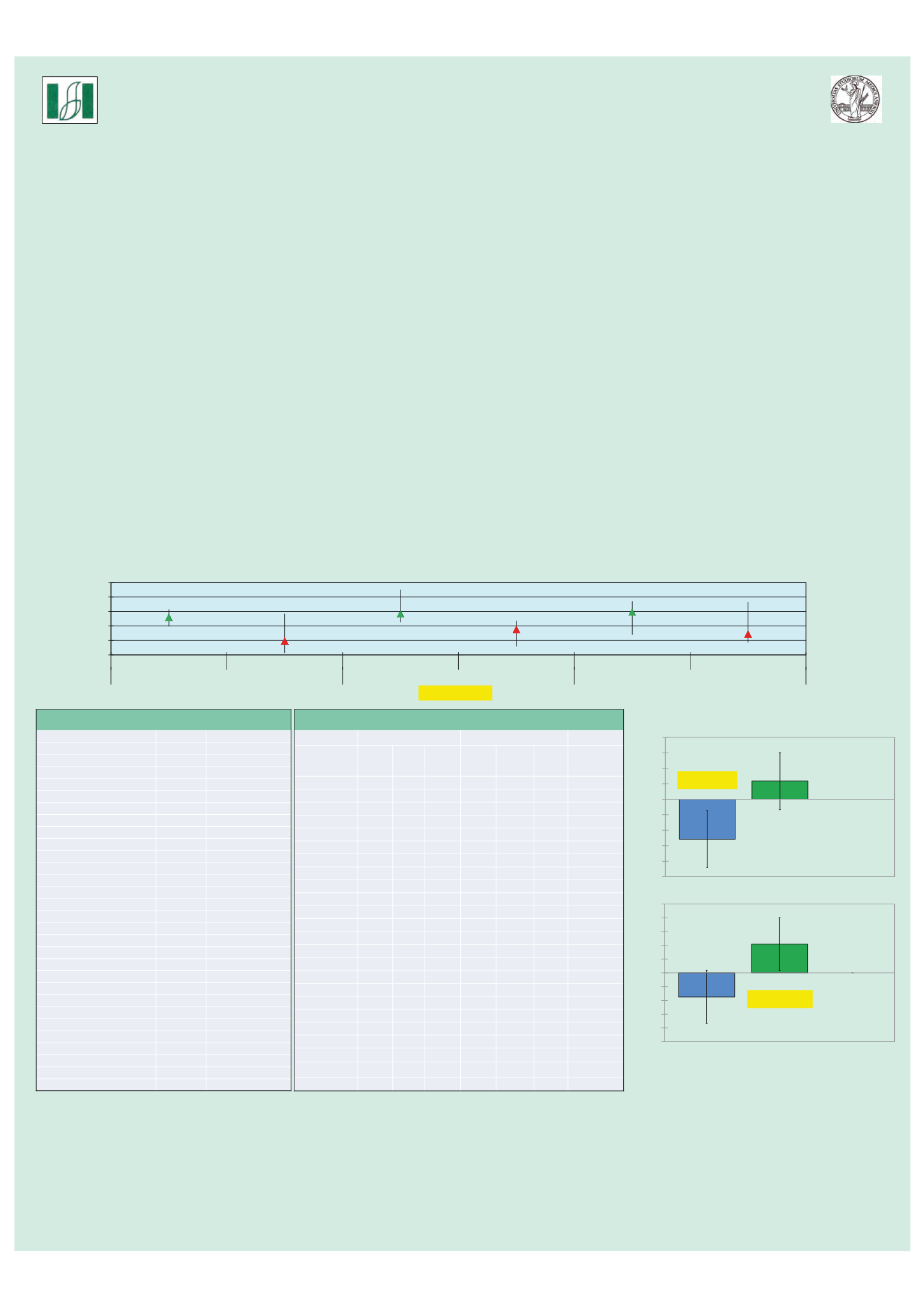
(1026-1907) vs 1012, IQR (838-1037); Mann-Whitney test. p=0,049]. Median increase in CD4 cells from 0 to 12 months was greater during the course of acute than recent infection
[284/μL, IQR (227-450) vs 176/μL, IQR (60-235); Mann-Whitney test, p=0.046]. This higher value was maintained through 18 months, although failing to reach statistical significance. Pts
with acute or recent infection did not significantly differ in virological success (83.3% vs 85.7% at 12 months).
Second, we considered CD4 cells gains at 6 months and detected an inverse correlation with CD4 levels at BL (r=-0.517; p=0.008) which persisted although without statistical significance
at 12 months (r=-0.350; p=0.072). The status of acute infection, compared to recent infection, appeared to be positively related to CD4 gains at 12 months (r=0.418, p=0.035); (ANCOVA).
Not only CD4 gain, but also the absolute count of CD4 T cells at 12 months appeared to be persistently higher, although not significantly, in pts displaying lower CD4 counts at baseline
who were pts treated during acute infection.
Finally, we took into consideration pts treated with 3 or 4 drugs and ruled out any significant difference in immunological or virological response (Mann Whitney and χ2 test).
Modification of therapy for tolerability took place in 4 out of 25 pts while receiving 4 drugs; 2 pts underwent simplification from a 4- to 3- drug regimen at the 6
th
month and subsequent
STI between 12 and 18 months following virological success.
Bibliography
[1] Panel on Antiretroviral Guidelines for Adults and Adolescents. Guidelines for the use of antiretroviral agents in HIV-1-infected adults and adolescents. Department of Health and Human Services. Available at
.
[2] Fiebig EW, Wright DJ, Rawal BD, et al. Dynamics of HIV viremia and antibody seroconversion in plasma donors: implications for diagnosis and staging for primary HIV infection.
AIDS
2003, 17:1871–1879
Conclusions
Treatment of primary infection appeared to be effective in preserving the pool of CD4 cells in acute more than recent infection, suggesting a greater efficacy of treatment started
during the earlier phases.
There was no evidence of a different outcome through the addition of a 4th drug to the standard treatment. Modification of therapy occurred in 4 pts while receiving 4 drugs and 2
pts underwent STI following virological success.
The presence of X4 strains during acute and recent infection is a rare though not absent phenomenon, accounting for possible transmission of these variants.
P 246
CHARACTERISTICS AT BASELINE
Age median (IQR)
38
IQR (29 - 47)
Female (%)
6
20,69%
Male (%)
23
79,31%
Italy (%)
28
96,55%
Africa (%)
1
3,45%
HE (%)
8
27,59%
IDU or Ex IDU (%)
1
3,45%
MSM (%)
19
65,52%
OTHER (%)
1
3,45%
HCV+ (%)
1
3,45%
Acute (%)
19
65,52%
Recent (%)
8
27,59%
nn (%)
2
6,90%
R5 (%)
20
68,97%
X4 (%)
2
6,90%
nn (%)
7
24,14%
FPR<2
1
3,45%
2<FPR<10
1
3,45%
FPR>10
15
51,72%
nn (%)
12
41,38%
Median CD4 /µL
486
IQR (411 - 655)
Median CD4%
25,5
IQR (18,9 - 35,9)
Median CD4 nadir/µL
475
IQR (411 - 616)
Median CD8 /µL
1091
IQR (848 - 1814)
Median CD4/CD8
0,44
IQR (0,33 - 0,93)
Median VL [Log]
5,26
IQR (4,26 - 5,94)
Median VL zenith [Log]
5,27
IQR (4,31 - 5,94)
4 initial drugs (%)
17
58,62%
3 initial drugs (%)
10
34,48%
0 initial drugs (%)
2
6,90%
Figure 2.
UNIVARIATE ANALYSIS
Acute = 18
Recent = 7
p
1°
Quartile Median
3°
Quartile
1°
Quartile Median
3°
Quartile
Mann
Whitney
vl_0 (Log)
4,95
5,44
5,99
4,23
5,08
5,53
0,380
vl_6 (Log)
1,34
1,57
1,57
1,28
1,57
1,57
0,327
vl_12 (Log)
1,28
1,57
1,57
1,28
1,42
1,57
0,302
vl_18 (Log)
1,50
1,57
1,57
1,28
1,42
1,57
0,134
vl_zenith (Log)
5,20
5,44
6,08
4,26
5,08
5,53
0,318
CD4_0
412
463
606
442
486
593
0,694
CD4%_0
17,50 19,40 29,80
23,48
28,25
31,00
0,172
CD4_6
685
708
815
576
643
802
0,485
CD4%_6
29,50 34,70 36,80
30,20
30,50
36,20
0,656
ΔCD4_6
198
260
313
14
96
284
0,280
ΔCD4%_6
5,75
9,70
12,78
4,53
6,55
8,58
0,184
CD4_12
678
832
1136
614
656
830
0,220
CD4%_12
28,40 34,80 41,00
27,03
30,30
34,63
0,172
ΔCD4_12
227
284
450
60
176
235
0,046
ΔCD4%_12
7,70
12,30 18,20
2,30
4,40
5,60
0,060
CD4_18
614
752
880
574
771
935
0,846
CD4%_18
28,75 33,90 37,25
32,43
34,50
39,05
0,613
ΔCD4_18
141
296
370
86
144
364
0,846
ΔCD4%_18
5,50
9,20
16,80
6,10
9,70
11,30
0,861
CD4_nadir
412
442
606
418
486
501
0,928
CD8_0
1026
1625
1907
838
1012
1087
0,049
%
%
χ
2
Success 6
88,89%
100,00%
0,853
Success 12
83,33%
85,71%
0,966
Figure 2.
Correlations between CD4 T cells gains and the
variables of CD4 cell count at baseline and Acute vs Recent
infection, at 6 and 12 months after starting ART (ANCOVA).
p=0.008
p=0.035
p = 0.046
CD4_0
Acute
Recent
-1
-0,8
-0,6
-0,4
-0,2
0
0,2
0,4
0,6
0,8
Correlation coefficient-r
Δ CD4_6 - 95%CI
CD4_0
Acute
Recent
-1
-0,8
-0,6
-0,4
-0,2
0
0,2
0,4
0,6
0,8
1
Correlation coefficient-r
Δ CD4_12 – 95% CI
Figure 1.
Median increase in CD4 count from baseline to 18 months during acute and recent infection, respectively (Univariate analysis).
0
100
200
300
400
500
Acute
Recent
Acute
Recent
Acute
Recent
6 months
12 months
18 months
Δ
CD4


