If this message is not displayed properly, click here please.

NEWSLETTER ESEB
December 2025

News

Letter from the Executive Committee

Dear ESEB Members,

Welcome to the December 2025 Newsletter.

Our major activity this year was the success of running the ESEB Congress in Barcelona, which was attended by around 2,000 delegates. We are processing questionnaire returns and will feed back information from this, but it is fair to say that the overwhelming reaction was positive. We all owe great thanks to Toni Gabaldón and his extensive team. A feature of the congress was the enthusiastic presence of our team at the ESEB desk, so special thanks to Nicki Cook, Ute Friedrich, Melinda Modrell and everyone who contributed to promoting ESEB business at the congress.

The congress usually results in turnover of people contributing to ESEB in a variety of roles. We would like to express our thanks to the following for their contributions:

Tracey Chapman, President 2023 – 2025
Astrid Groot, Past President 2023 – 2025
Josefa González, Vice-President 2023 – 2025
Ellen Decaestecker, Secretary 2021 – 2025
Toni Gabaldón, Congress Organiser 2025

We are extremely grateful to all of them for helping ESEB move forward, but particular thanks must be given to Tracey for her service as President.

We are grateful to the following for taking on new roles:

Sara Magalhães, President-elect 2025 – 2027
Deepa Agashe, Vice-President 2025 – 2027
Jonna Kulmuni, Secretary 2025 – 2029

Once more, we are extremely appreciative to everyone for taking on these roles and supporting your society.

Alongside the congress we have continued to promote ESEB’s activities and aims. A special mention should be made to the Special Topics Networks which are now such a strong and popular feature of the ESEB proceedings, and producing a series of great special issues, reviews and other articles for our journals.

One feature we have noted in discussion with members is a little confusion about the roles of the journals. The Journal of Evolutionary Biology (JEB) is our flagship journal and its success is critical to the successful running of the society. While there are a variety of opinions about the contemporary publishing landscape, the hybrid format of JEB (Open Access and subscription) currently generates the vast majority of our income, without which we could not operate in the way we do. The equivalent journal for our partner society, SSE is, of course, Evolution. Together with SSE we launched Evolution Letters in 2017 as a joint Open Access journal to highlight the best evolutionary research papers. We believe that Jon Slate initially and now Judith Mank have successfully established this as a premier journal in our area.

As stated frequently at the Congress and elsewhere we again emphasise that supporting society journals helps ensure the long-term success of the society.

2026 is an unusual summer in that we are not running either an ESEB or joint congress, though we are sure that there will be many other venues offering opportunities for presentations and networking. Of course, in 2027 we will run our first ever ‘Hub’ meeting. As a reminder, this will be a dispersed congress, with the 4 hubs located in Munich (lead, Aurelien Tellier), London (Max Reuter), Gothenburg (Kerstin Johannesson) and Istanbul (Mehmet Somel). Aurelien is leading the overall organization, with assistance from the other hub leads and Kees van Oers (ESEB Exec VP). The idea is that we would recommend that members avoid flights when travelling to their nearest Hub to attend the congress, to reduce environmental impact. Work continues apace to set out the arrangements and technical details for running a joint programme across the venues. The 2027 congress promises to be an innovative experiment in sustainable congress organising, and we are proud to be leading on this. We will carefully evaluate the outcome of the 2027 congress before deciding whether to adopt such meetings into our regular schedule.

2029 is now confirmed to be a joint congress with SSE, ASN & SSB and we are delighted that Ellen Decaestecker and colleagues at the KU Leuven and Ghent University will organise this.

All participants at these upcoming congresses should abide by the ESEB Code of Conduct  and ESEB Code of Ethics, to ensure safety and inclusion for our members in ESEB-facing activities.

Please enjoy reading the information contained in the Newsletter. We believe that academic societies are extremely important, perhaps never more so. We encourage everyone to support ESEB and invite your students, friends and collaborators to join. Of around 1,500 attendees at the Barcelona congress who responded to the survey, around 500 were ESEB members and almost as many were not a member of any academic society. We look forward to having more ESEB members, who can also then benefit from the award schemes, Special Topic Networks and other networking opportunities provided by ESEB.

The Executive Committee
Mike Ritchie, Jonna Kulmuni, and Kees van Oers

Congresses

EMPSEB31 in 2026

The 31st European Meeting for PhD Students in Evolutionary Biology (EMPSEB) will take place in Oberwiesenthal, Germany, from 8 - 12 June, 2026.

REGISTRATION IS NOW OPEN!

More information is available at the EMPSEB31 website

Save the date!

The ESEB Hub Congress will take place from 16 – 20 August, 2027 in

Munich (Germany),
London (United Kingdom),
Gothenburg (Sweden), and
Istanbul (Turkey),

organized by Aurélien Tellier and colleagues.

Please check the congress website for updates.

Journals

Journal of Evolutionary Biology

Call for editorial board members

We are looking for new editors to join the board of the Journal of Evolutionary Biology (JEB) in February 2026. We publish our journal in partnership with Oxford University press under a not-for-profit model. Proceeds from publishing JEB are channelled back into the evolutionary biology community and fund ESEB initiatives such as travel awards for Early Career Researchers, networking and meeting opportunities and supporting the ESEB biennial congress.
Call for JEB editors
Our editorial board consists of a small group of Handling Editors (who triage manuscripts and make final decisions across wider areas within evolutionary biology), supported by a larger board of Associate Editors (who oversee the peer review and recommend decisions to the Handling Editors, based on their specialist expertise). JEB also has a Commissioning Editor, a Data Editor, a full-time Managing Editor and of course our Editor-in-Chief Max Reuter. We are currently seeking several Associate Editors and a Handling Editor. Please click here for more information and how to apply.

Special Content in JEB

JEB publishes a range of article types, including research articles, methods articles and perspectives and we encourage you as ESEB members to consider us for your work—we are your society journal! At the moment, we are particularly looking for more [Reviews and Target Reviews]. If you have something that could suit these types, please submit directly or contact us with an enquiry, our Commissiong Editor Rich Meisel would be very glad to hear from and advise you.

Likewise, we encourage you to sign up for our electronic tables of contents and browse our issues. While you’re there, also have a look through our Special Issues. Many of these originate from ESEB congress symposia and are a true reflection of the current research output of the evolutionary biology community. For the latest of these, look out for Special Section “Beyond ATP: new insight into mitochondrial function and evolution” in the December issue of JEB, guest edited by Andrea Pozzi and Sophie Breton.

Open Science at JEB

As you know, we at JEB are taking Open Science seriously. We require all data associated with published articles to be archived and for more than three years now our Data Editor Sebastian Lequime has advised our authors on how to improve their archives. This is working very well and will continue in the future. However, we are making a small change to our list of recommended repositories. Specifically, we will no longer recommend Dryad as one of our preferred platforms. Dryad has been and remains an excellent repository, with excellent data curation and behind-the-scenes admin features. But the cost for depositing datasets (so far paid for by ESEB for JEB authors) have increased to a point where we no longer believe they are money well spent, especially when our data editing provides effective curation and free alternatives such as Zenodo and Figshare are avaiulable. You can read more about the thinking behind this decision in this blog post.

Somewhat related to data and transparency, we have also added some guidelines on statistical reporting to our Author Instructions. We realised that neither JEB nor any of our fellow evolution journals provided this, despite the central importance of statistics in the validity and interpretation of the reported results. You can see our guidelines here.

Evolution Letters


Evolution Letters, which is jointly owned by ESEB and SSE, primarily publishes original research articles, or Letters, in all areas of evolutionary biology, spanning genes, genomes and phenotypes. The journal also publishes Comment and Opinion and Review articles that discuss timely new research developments or themes of emerging impact. Check out our Why Publish with Us and Author Guideline pages for more information, or email us if you have any questions!

Picture T. Schwander
 
We are excited to announce that Professor Tanja Schwander (University of Lausanne, Switzerland) will be joining the Evolution Letters Editorial Board in January 2026! Tanja’s research focuses on the evolution and diversity of reproductive and genetic systems in animals.
 
 
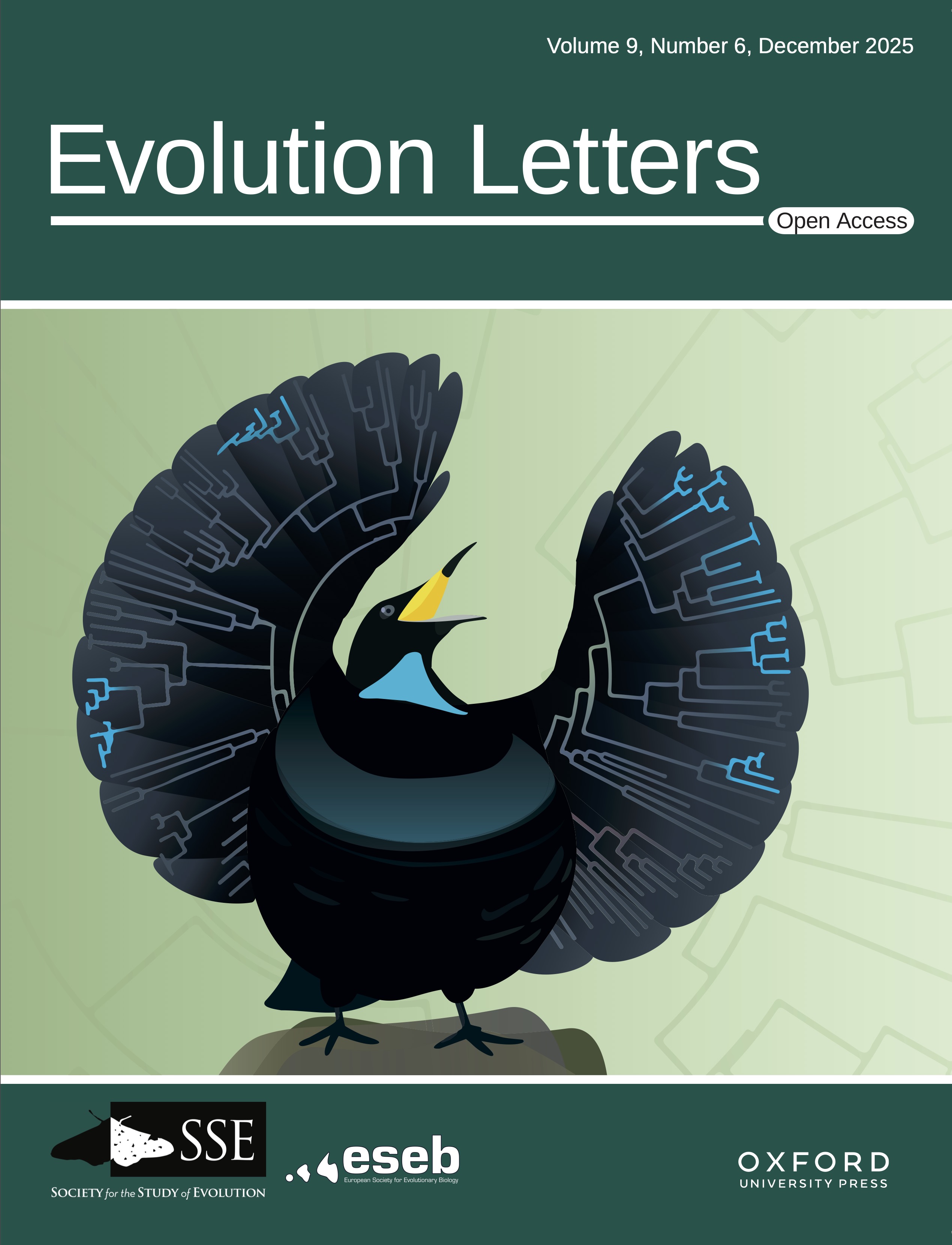
The December issue of Evolution Letters is out!
Check out all of our latest articles including the Editor’s choice: Sexual selection and speciation: a meta-analysis of comparative studies by Tim Janicke, Tamra Mendelson, Michael Ritchie, Lucas Marie-Orleach and Jeanne Tonnabel.Praesent laoreet malesuada cursus. Maecenas scelerisque congue eros eu posuere. Praesent in felis ut velit pretium lobortis rhoncus ut erat.
Cover illustration by Katharina Bóth

ESEB Calls

January 2025

graphic JMS Prize call 2026
graphic Conference Travel award 2026
graphic GHMA 2026

February 2025

graphic CAA grant call 2026

March 2025

graphic GEBI call 2026
graphic Outreach Initiative Call 2025

Membership

Join ESEB

New 2-year subscriptions will be available at the end of December, valid from 1 January 2026 - 31 December 2027.

  1. Regular membership € 80
  2. Student membership € 40
  3. Life-time membership € 800

Memberships are personal subscriptions and include 21% VAT.

Discounts are available for researchers professionally based in countries with low, lower-middle and upper-middle incomes due to the rating at the World Bank.

Renew your membership for 2026

Renewal letters will be send out in late December. If you would like to change your subscription type, e.g., from a student to a regular subscription, please contact U. Friedrich at membership@eseb.org before renewing.

In case you have a discounted membership, please send a proof of your continuing eligiblility to membership@eseb.org in December.

Sundries

Resources for Inclusive Evolution Education:
Testing the impacts of socially-conscious education materials for evolution in undergraduate classrooms

Dear colleague,

We are a group of evolutionary biologists and biology education researchers conducting a collaborative research project to understand the impacts of inclusive evolutionary biology educational materials on biology undergraduates, with the hope that these materials enhance awareness of the misapplications of evolutionary concepts to human society by students. Our interdisciplinary collaboration, known as the Resources for Inclusive Evolution Education (RIE2) group, has generated teaching modules that take a new approach to presenting several complex concepts in evolutionary biology.

We are explicitly looking for instructors of biology and evolution courses at US and Canadian colleges and universities to pilot our module on adaptation (found here) in spring 2026. To test the efficacy of this module, we have designed an experiment that manipulates the module to feature either traditional examples of adaptation (e.g., bird bills/beaks) or examples that ask students to consider how adaptationist thinking may be misapplied to humans during the third day of instruction. 

If you are interested in participating in this study, we will ask you to use approximately one week of your course (2-3 classes) to implement our module on adaptation and have students fill out a survey that characterizes their experiences with the module before and after interacting with the provided course material. 

Selected instructors will receive $250 compensation for full participation. 

For more information about this study, please read the attached information letter. If you are interested in participating as an instructor in this study, please fill out the survey below to express your interest by December 12th, 2025:

https://sunybuffalo.qualtrics.com/jfe/form/SV_1ZYMiROU7fkhcbk

Priority will be given to instructors who express interest by December 12th, but we will consider other applications on a rolling basis. We will meet with all instructors teaching these modules in early January 2026.

To help spread the word, please forward this message to any instructors of introductory biology or evolution classes in your biology department.

Thank you for helping with our efforts to improve evolutionary biology education in undergraduate classrooms, and please reach out with any questions. We look forward to hearing from you.

Invitation information: https://drive.google.com/file/d/15jFchVp09eAaoRIx37Tq1v1-NrcGGe6M/view?usp=sharing


All the best,

Nancy Chen, Assistant Professor, University of Rochester (starting 2026: UCLA)
Robin Costello, Assistant Professor, University at Buffalo
Kiyoko Gotanda, Assistant Professor, Brock University
Carolyn Graham, Postdoctoral Researcher, University at Buffalo
Suegene Noh, Associate Professor, Colby College
Yaamini R. Venkataraman, Assistant Professor, Santa Clara University

If you don't want to receive any more messages, you can unsubscribe here at any time.
European Society for Evolutionary Biology
office@eseb.org
ESEB homepage