

Identification of sources of Aspergillus nosocomial infection is of great potential value for the healthcare of severely immunocompromised patients (i.e. due to chemotherapy or transplant recipients). There is an article here written for this website by Dr Amanda Barnes which discusses this subject in detail.
|
|
|
This article examines in detail the dynamics of spore retention and release of a variety of textiles.
Cotton fabrics tended to retain spores (figure on left) and then release them over an extended period of time. It is easy to imagine that spores retained in cotton garments would act as an efficient reservoir for infection if carried to the bedside of an immunocompromised patient. The spores would tend to be released when anything rubbed against the garment during use. Wool (figure on right) is suggested to have similar properties.
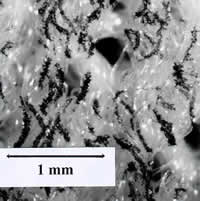
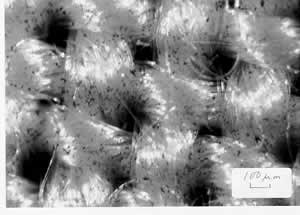
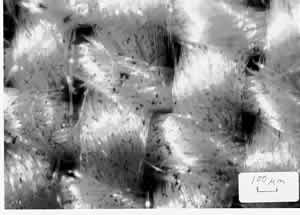
Synthetic fibres such as rayon and polyester have much smoother fibres and tended to retain spores by a different mechanism - that of electrostatic attraction. Because of this property this type of cloth also retains spores quite well. In the first 20 seconds only the loosely held spores are lost on polyester and rayon (e.g. spores that lie on top of other spores, or spores with lower fibre contact area as a result of the fabric morphology). Unlike cotton, there is not a good physical entrapment mechanism to retain loosely held spores, so they are potentially quite rapidly removable in an airstream. However, the number of spores released will depend upon the amount of force applied (i.e. the airstream velocity or a frictional component), so there are frequently residual spores left on the clothing (see figure below).
 |
 |
|
Polyester fibre soiled with dry Aspergillus spore powder showing how the spores line up along the surface of the fibre, strongly suggesting electrostatic attraction. |
Rayon challis fibre (higher moisture content than polyster) - the spores disperse more evenly on this type of fibre. |
 |
|
|
Rayon challis fibre after exposure
to airflow |
|